
The internet is a noisy place. Between promotional newsletters, mandatory signups, and persistent marketing trackers, keeping your personal inbox clean is a constant battle. This is why temporary email services have become popular tools for both casual users and software developers. But with numerous options available, how do different services compare?
In this guide, we review and compare 10 popular disposable email providers in 2026 based on domain availability, message delivery speed, privacy trade-offs, and user experience. Whether you need a simple inbox for developer testing or a fast OTP receiver, each tool has unique strengths and limitations.
Evaluation Criteria
To provide a clear, balanced comparison, we evaluated each service using these practical dimensions:
- Domain Variety: The selection of active domains offered for inbox routing.
- Delivery Latency: The speed with which incoming verification emails appear in the web interface.
- Data Retention: How long emails and sessions persist before being cleared.
- User Interface: Clarity, ease of navigation, and responsiveness on mobile screens.
- Developer Utilities: Support for custom aliases, APIs, and test data utilities.
Provider Comparison Table (2026)
| Service | Domains | Expiry Duration | Registration | Custom Alias |
|---|---|---|---|---|
| Free Mail (30mail.in) | Multiple Curated Domains | 10, 30, or 60 Mins | No | Yes |
| Guerrilla Mail | 11 Suffixes | 60 Mins | No | Yes |
| 1secMail | 8 Suffixes | Session-based | No | No |
| Mailinator | Public Mailbox Pool | Few Hours | No | Public Any Name |
| TempMail.org | Rotated Pool | Manual / Cookie-based | No | Premium Tier |
Provider 1: Free Mail (30mail.in)
30mail.in is a modern, lightweight temporary email service designed for instant in-browser access. Built on Next.js with real-time WebSockets, incoming messages display immediately without manual refreshing.
Key Characteristics
Free Mail provides configurable session timers (10 minutes, 30 minutes, or 60 minutes) and allows users to pick from several active domains. It also links directly with a Test Data Generator for developer QA testing.
Strengths and Limitations
- Strengths: Real-time WebSocket delivery, modern mobile UI, no registration, receive-only architecture that prevents spam relaying.
- Limitations: Does not support outbound email sending; addresses are purely ephemeral.
Provider 2: Guerrilla Mail
Guerrilla Mail is one of the longest-running services in the temporary email space, operating since 2006. It offers reliable inbox generation and several memorable domains like @sharklasers.com.
Trade-offs: Guerrilla Mail uniquely supports composing and sending short outbound emails, which few other services allow. However, its interface remains dated, and many of its domains are widely cataloged in public blocklists.
Provider 3: 1secMail
1secMail is favored by developers because of its simple, documented HTTP REST API. It is fast, lightweight, and requires no browser JavaScript to fetch message contents programmatically.
Trade-offs: For interactive desktop users, the user interface is minimal and lacks advanced organization or automatic clipboard helpers.
Provider 4: Mailinator
Mailinator is an established standard for QA software testing. Any email sent to anything@mailinator.com can be read publicly by anyone who navigates to that inbox name.
Trade-offs: Excellent for open developer testing and continuous integration suites. However, because all public inboxes are unauthenticated and readable by anyone, it must never be used for confidential information.
Provider 5: TempMail.org
TempMail.org is one of the most widely recognized consumer temporary mail services, featuring polished native mobile apps for iOS and Android.
Trade-offs: It has a sleek user experience, but advanced domain choices and custom addresses are locked behind a paid subscription tier.
Provider 6: Throwam (Throwawaymail)
Throwam offers a straightforward, single-purpose interface focused on quick 10-minute temporary email sessions. It loads quickly with minimal cognitive overhead.
Provider 7: Mail.tm
Mail.tm provides a modern, fast interface with full REST API support and token-based account handling. It is popular among developers who need programmatic control over ephemeral accounts.
Provider 8: YOPmail
YOPmail allows users to access any inbox name without prior generation and stores messages for up to 8 days. This extended window is useful when waiting for delayed responses, though inboxes are publicly readable if the name is known.
Provider 9: Dispostable
Dispostable offers an ultra-minimalist layout. Users can type any address ending in @dispostable.com and check incoming messages. Because it relies primarily on a single domain, that domain is frequently filtered by third-party forms.
Provider 10: TrashMail
TrashMail operates primarily as an email forwarding service. Instead of a standalone web inbox, it forwards incoming emails to your real inbox for a set number of messages or days before self-terminating.
Choosing the Right Tool for Your Needs
The optimal service depends on your specific workflow:
- For QA and Developer Testing: Mailinator and Mail.tm offer excellent public testing and API automation.
- For Fast, Clean Web Inboxes: Free Mail (30mail.in) delivers instant WebSocket speed with clean modern controls.
- For Outbound Messaging: Guerrilla Mail remains one of the few options that supports sending messages.
- For Extended Multiday Access: YOPmail provides up to 8 days of message retention.
📊 Traditional Email vs. Temporary Email Privacy Architecture Chart
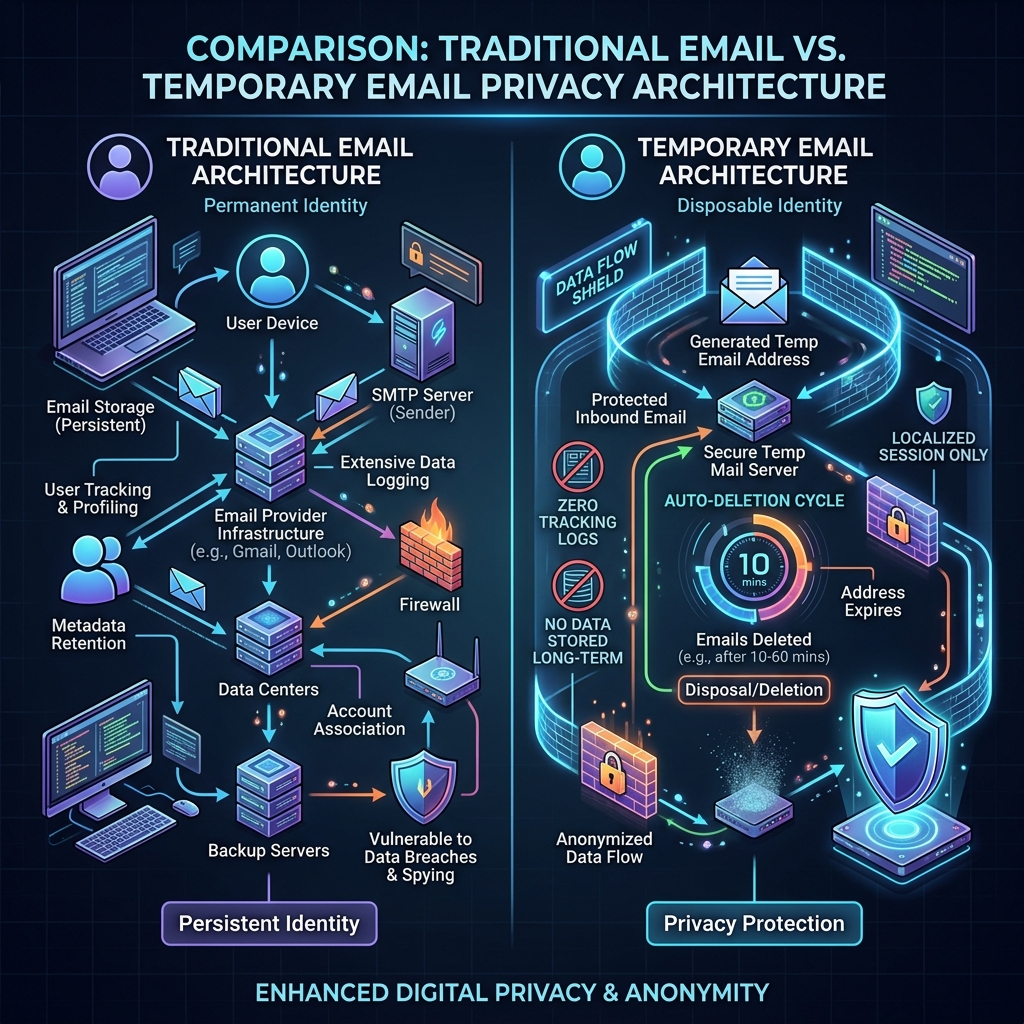
Architecture overview illustrating real-time WebSocket delivery and automatic memory deletion cycles at 30mail.in.
Frequently Asked Questions
Some platforms maintain lists of public disposable domains to ensure users provide reachable contact information. Rotating domains helps testing.
Most reputable disposable email services operate strictly in receive-only mode to prevent outbound spam relays.