
As workplace monitoring tools and corporate IT security measures become more sophisticated, many professionals ask important questions about privacy boundaries. When is it appropriate to use a secondary or temporary email address for work-related activities, and when should you stick to official company channels?
The distinction is critical: while temporary email tools can protect your personal contact information when registering for external industry webinars, testing software tools, or researching market competitors, using unauthorized addresses for official company business can violate security policies.
Understanding Workplace IT Monitoring & Email Privacy
When you use an employer-issued email address (e.g., alex@company.com) or connect to your company's network or VPN, your communications are governed by enterprise security guidelines:
- Corporate Email Auditing: Employer-provided email accounts are the property of the organization. IT teams can audit, search, and archive messages in accordance with legal and compliance mandates.
- Network Web Filtering: Enterprise networks and VPN gateways log DNS lookups, connected domain names, and external traffic endpoints.
- Data Loss Prevention (DLP): Security software monitors outbound files and text streams to prevent proprietary code, customer records, or financial data from leaving the corporate perimeter.
Legitimate Scenarios for Secondary Inboxes at Work
There are valid professional scenarios where using a secondary or temporary email address makes sense:
1. Attending Vendor Webinars & Downloading Industry Whitepapers
Downloading software whitepapers or signing up for third-party tech webinars often triggers relentless automated email outreach from vendor sales representatives. Using a temporary address on 30mail.in lets you read the documentation without clogging your corporate inbox with sales calls.
2. Conducting Competitor Benchmarking & Market Research
If your role requires studying competitor onboarding flows, pricing calculators, or public newsletters, signing up with an official company domain immediately flags your research to their sales team. Using a dedicated secondary research email ensures neutral, unhindered observation.
3. Completing Anonymous Industry Salary Surveys
When contributing salary data or workplace reviews on third-party compensation portals, using a secondary address ensures your personal submissions are completely decoupled from internal corporate systems.
High-Risk Scenarios to Avoid
Conversely, using personal or disposable emails in the following contexts can lead to policy violations or security risks:
- Official Employment Documents & Benefits: Never use a temporary email for payroll, tax documentation (W-2, Form 16), benefits enrollment, or binding NDAs.
- Transmitting Proprietary Code or Data: Forwarding company source code, internal spreadsheets, or customer data to external inboxes is a severe compliance violation.
- Impersonating Colleagues: Creating secondary accounts to speak on behalf of colleagues or managers is unethical and legally actionable.
Workplace Email Usage Matrix
| Scenario | Recommended Channel | Risk Level |
|---|---|---|
| Downloading vendor whitepapers | Temporary Email (30mail.in) | 🟢 Safe & Practical |
| Competitor research & public demos | Secondary Research Email | 🟢 Safe & Practical |
| Anonymous industry salary surveys | Personal / Secondary Email | 🟢 Safe |
| Internal Slack, Jira & HR onboarding | Official Corporate Email | 🔴 Required by Policy |
| Transmitting confidential client files | Sanctioned Corporate Storage | ⚠️ High Risk if using temp mail |
Summary
Using secondary and temporary email tools for market research, vendor evaluations, and external webinar registrations is a practical way to keep your primary work inbox organized. However, always ensure your activities comply with your organization's IT security rules and keep confidential communications within authorized corporate channels.
📊 Traditional Email vs. Temporary Email Privacy Architecture Chart
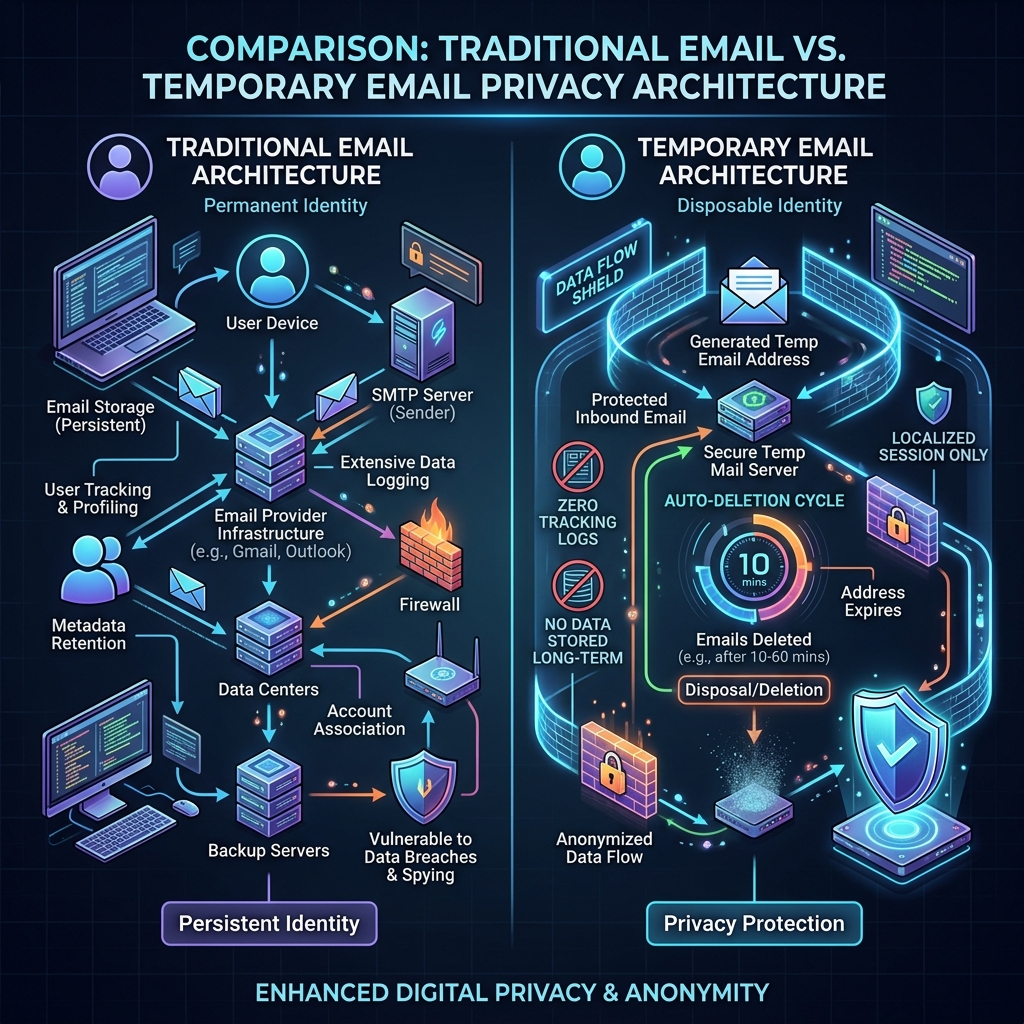
Architecture overview illustrating real-time WebSocket delivery and automatic memory deletion cycles at 30mail.in.
Frequently Asked Questions
Corporate web filters log visited URLs on company networks, but encrypted HTTPS/WebSocket contents remain private.
Yes. Using neutral secondary inboxes for market benchmarking and vendor whitepapers is a standard industry practice.