
If you have ever needed a quick, disposable inbox, you have likely encountered Guerrilla Mail. Founded in 2006, Guerrilla Mail is one of the original pioneers of temporary email. Over the past two decades, however, web architecture, mobile browsing standards, and security protocols have evolved dramatically.
In this technical comparison, we examine how Guerrilla Mail compares to Free Mail (30mail.in) across architectural design, mobile usability, delivery speed, and feature capabilities.
Comparison Overview
| Feature Dimension | Guerrilla Mail | Free Mail (30mail.in) |
|---|---|---|
| Inception | 2006 | Modern (Next.js & WebSockets) |
| Delivery Architecture | AJAX Polling | Real-Time WebSockets |
| Send Outbound Emails | Yes (Short messages) | No (Receive-only for safety) |
| Interface Design | Traditional desktop layout | Modern, responsive, mobile-first |
| Developer Utilities | Scrambled address helper | Integrated Test Data Generator |
Guerrilla Mail: Strengths and Best Use Cases
Guerrilla Mail has maintained consistent uptime for nearly twenty years. Its most distinct capability is supporting outbound email composition. While the vast majority of temporary email platforms disable outbound sending to prevent spam relay abuse, Guerrilla Mail allows users to send short text emails from their temporary addresses.
Key Strengths:
- Outbound Email Capability: Useful if you need to reply anonymously to an inquiry.
- Address Scrambling: A feature that obscures your chosen inbox alias to prevent unauthorized mailbox access.
- Established History: Decades of continuous operation make it a dependable benchmark.
Free Mail (30mail.in): Strengths and Best Use Cases
Free Mail was engineered to address modern web expectations: instant real-time message delivery, zero registration, and seamless mobile responsiveness.
Key Strengths:
- WebSocket Speed: Messages arrive instantaneously over persistent WebSocket connections without manual page reloads, making verification codes easy to view.
- Receive-Only Security: By strictly disallowing outbound email, the service eliminates spam relaying and maintains higher reputation across mail systems.
- Modern Mobile UX: Designed with clean CSS, dark mode support, and full mobile optimization.
- Developer & QA Tools: Includes a dedicated Test Data Generator and Bulk Verifier for application testing.
Which Service Fits Your Workflow?
Both tools serve valid purposes within different operational workflows:
- Choose Guerrilla Mail if your use case specifically requires sending an outbound reply from an ephemeral address.
- Choose Free Mail (30mail.in) if you are validating verification links, testing web apps on mobile or desktop, and prefer an instant, ad-light interface with zero setup.
Conclusion
While Guerrilla Mail deserves respect for pioneering disposable email, modern users frequently benefit from the real-time speeds, mobile responsiveness, and clean architecture of Free Mail. Evaluate both tools to see which best aligns with your personal privacy or developer testing requirements.
📊 Traditional Email vs. Temporary Email Privacy Architecture Chart
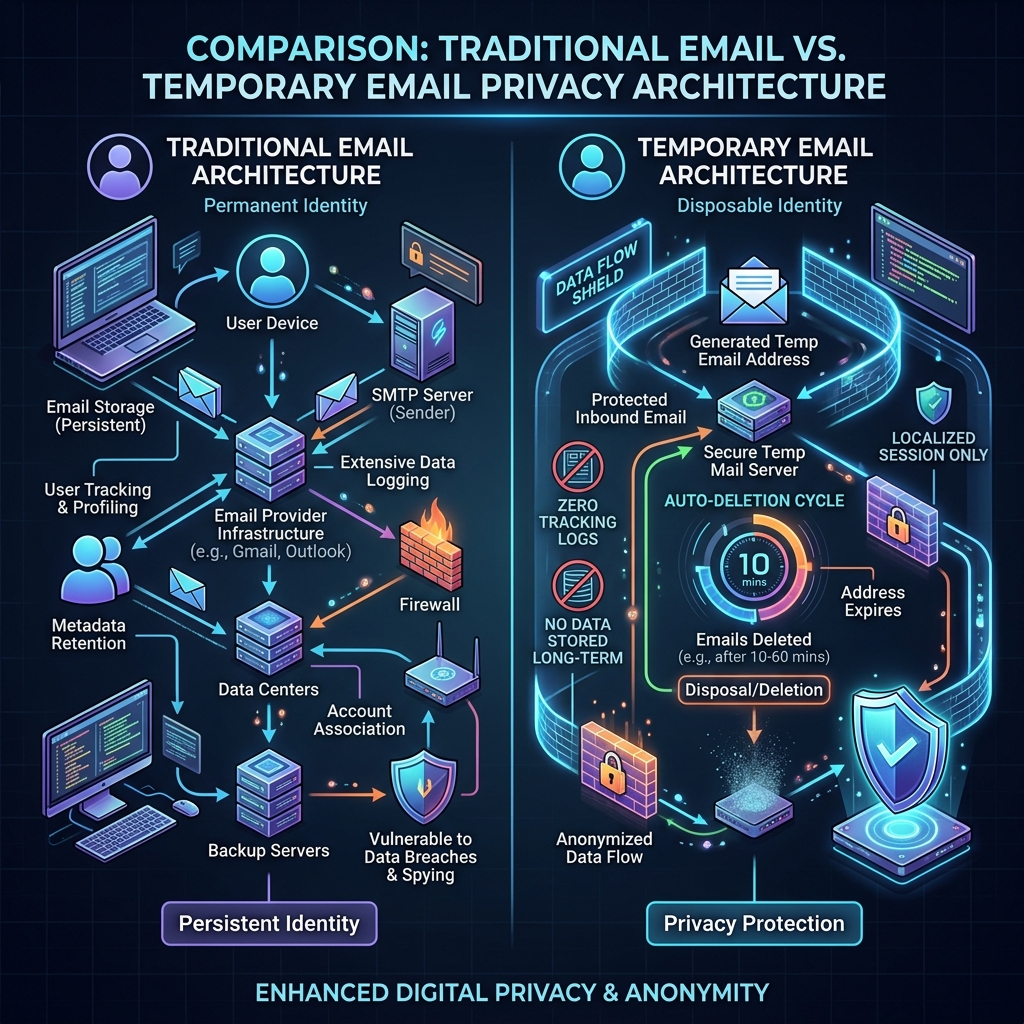
Architecture overview illustrating real-time WebSocket delivery and automatic memory deletion cycles at 30mail.in.
Frequently Asked Questions
Modern services use WebSockets for real-time delivery, whereas traditional tools rely on periodic AJAX polling cycles.
Guerrilla Mail supports sending short text messages, while Free Mail is receive-only to maintain strict spam prevention standards.